Schein und Sein in Havanna
Viele historische Gebäude von Kubas Hauptstadt Havanna sind vom Zerfall bedroht. Seit 1982 steht die Altstadt Havannas unter dem Schutz des Unesco Weltkulturerbes. Die New York Times berichtet heute im Artikel Old Havana Gets a Lift, wie das Erbe in einem gross angelegten Renovationsprogramm gepflegt und für die Touristen herausgeputzt wird.
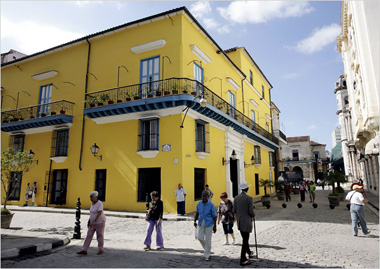
Herausgeputzt: Gebäude der Altstadt von Havanna (New York Times)
Ein kritischer Artikel, der einen interessanten Einblick in die Mechanismen der kubanischen Tourismusstrategie und in den Alltag von Kubas Menschen gibt:
Yet the renovation has only gone so far, and tens of thousands of people are still trapped in squalid buildings just blocks from the refurbished zones, giving rise to grumbling among some residents that the renovation amounts to a Potemkin village for visitors. They point out that few Cubans can afford the $7 drinks at the Floridita, and by law Cubans cannot stay in the restored hotels, even if they could afford the rates of $150 a night.
“The reconstruction doesn’t have anything to do with the state system we live in,” said Yadira Amoros, a 30-year-old single mother who was using a plumber’s wrench to try to get water flowing to her dingy apartment a block from Calle Obispo. “None of this benefits us.”
Trotz tiefer Nahrungsmittelpreise, kostenloser medizinischer Versorgung und Schulen reiche das reguläre Einkommen vieler Kubaner kaum zum Leben, rechnet die New York Times vor.
“Everyone has to do something,” said one man, who ran a state-owned grocery store for a $12 salary. “I sell cigars.”